Will the Continents Collide Again Highest Number
The World's continents are in constant motion. On at to the lowest degree 3 occasions, they have all collided to form one giant continent. If history is a guide, the current continents will coagulate once again to grade another supercontinent. And a study in Nature now shows how that could come up near.
Yous can think of continents as behemothic puzzle pieces shuffling around the Globe. When they drift autonomously, mighty oceans course. When they come together, oceans disappear. And it'due south all because continents sit on moving plates of the Earth'south crust.
A new model of continental drift predicts that the next supercontinent could form near the Northward Pole — in another 100 million years or so.

Two of the previous supercontinents, which formed 200 one thousand thousand years agone (Pangaea) and 800 meg years ago (Rodinia). Mitchell, et. al./Nature hide caption
toggle caption
Mitchell, et. al./Nature
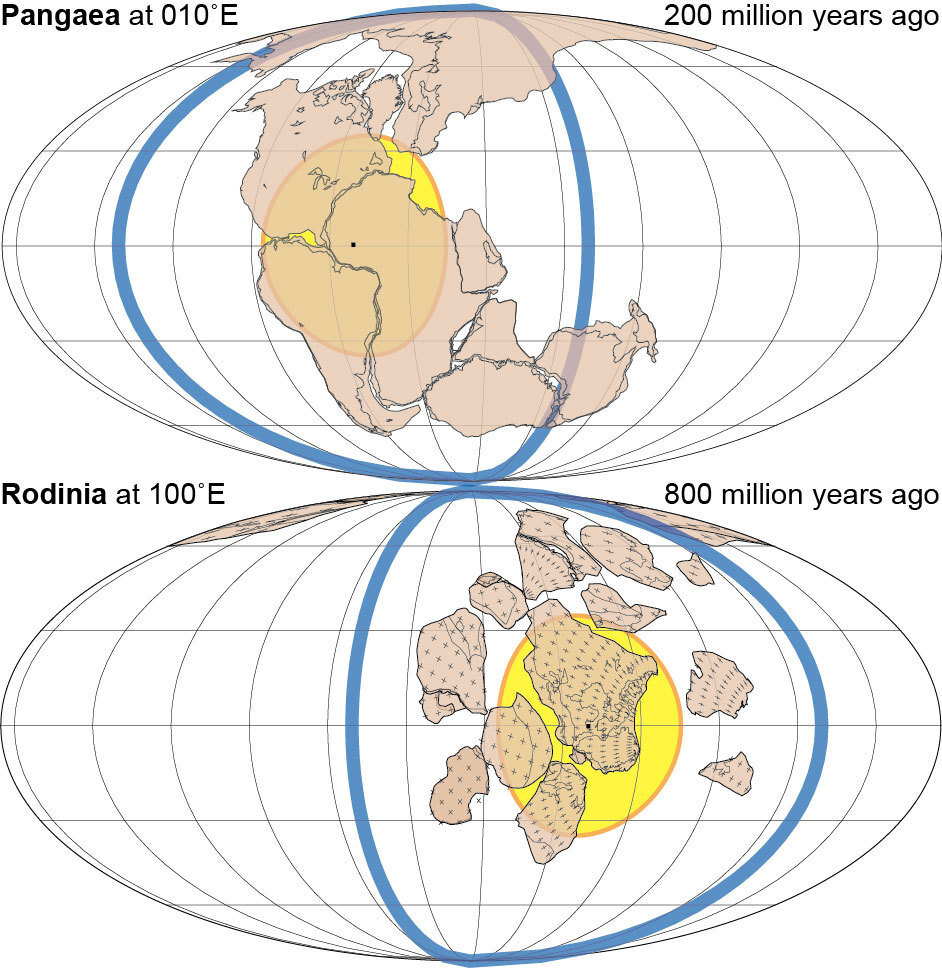
Two of the previous supercontinents, which formed 200 meg years ago (Pangaea) and 800 million years ago (Rodinia).
Mitchell, et. al./Nature

The Americas and Asia may fuse together to class a new supercontinent, "Amasia." Mitchell, et. al./Nature hide explanation
toggle caption
Mitchell, et. al./Nature

The Americas and Asia may fuse together to form a new supercontinent, "Amasia."
Mitchell, et. al./Nature
"Continents on these plates typically move, I would say, at the rate your fingernails grow," says Ross Mitchell, a graduate educatee at Yale University. That may seem slow, but information technology adds upwards over hundreds of millions of years.
Await at an atlas and you lot can imagine how Africa and South America, for example, once nestled together.
"Rewind the tape and bring all the continents back into their jigsaw arrangement, you have this vast landmass of all the World's continental blocks together," Mitchell says.
Last time all the landmass clumped up, it formed a supercontinent chosen Pangaea. The dinosaurs walked at that place. But Pangaea wasn't the kickoff.
"There had been three, perhaps a debated quaternary supercontinent through the billions of years," Mitchell says.
He has been studying that deep history by looking at tiny magnets cached in rock around the world. Those magnets pointed north when they were locked into the rock. Sample those magnets in layers of rock laid down over millions of years, and you tin tell the story of how those continents take moved.
And naturally, that led Mitchell to wonder what the side by side supercontinent will look like.
In that location have been two leading ideas. One is that the continents will collapse together over again at the site of the last supercontinent, centered on Africa. That would squeeze the Atlantic Bounding main shut. The other idea is that the Atlantic would keep growing and growing.
Nether this scenario, "a supercontinent rifts apart, and the continents skirt effectually to the reverse side of the world, re-creating the next supercontinent, 180 degrees on the opposite side of the globe from the previous one," Mitchell says.
That would get out us with a supercontinent in identify of the Pacific Ocean.
A Supercontinent Called Amasia
But Mitchell's research for his Ph.D. thesis suggests both those ideas are wrong. Instead, he says the continents seem to be moving north. That ways the Caribbean Sea and the Arctic Ocean will be squished shut.
"Think about endmost the Caribbean Sea — you have now fused N and South America," Mitchell says. "And then by fusing the Arctic Sea, you would suture the Americas with Eurasia."
850 1000000 Years Of Drifting
The state on World is moving, but slowly — about equally fast as your fingernails grow. If we plough the clock back 850 meg years, we can see how the continents grew apart and back together several times.
That would create a supercontinent chosen Amasia that would class at the top of the Globe. Somewhen it would slump south toward the equator. And nether this scenario, Antarctica might remain isolated at the lesser of the world.
Brendan Murphy studies supercontinents at St. Francis Xavier Academy in Nova Scotia. He says the Yale squad's idea is provocative, innovative and plausible.
"What they've washed is they've thrown some other possibility out in that location that, quite bluntly, many of us hadn't really idea about. And so even if the model is incorrect, we will larn a lot past testing it."
And he says the challenge isn't merely finding different means to put together the Earth's jigsaw puzzle continents.
"This is really important because it influences the evolution of our unabridged planet, including life that lives on information technology," Irish potato says. "For instance, many people believe that supercontinents course and stood autonomously their fundamental changes in climate."
Of grade, the next supercontinent isn't likely to class for another 100 million years or so. And Mitchell says the human species will probably be long gone by then, so nosotros won't know, "only it's certainly fun to retrieve about."
felicianosmandertne.blogspot.com
Source: https://www.npr.org/2012/02/08/146572456/amasia-the-next-supercontinent
0 Response to "Will the Continents Collide Again Highest Number"
Postar um comentário