what were the colonists reaction to the declaratory act

The Declaration of Independence
Lesson Plan
The Townshend Acts
- What were the fundamental provisions of the Townshend Acts and what was the rationale of Charles Townshend and the British Parliament in passing the kind of legislation that they did?
- What was the colonists' reaction to the Human activity?
- Why was Parliament surprised past the colonists' reaction to the Human action and what was the British response to the colonists?
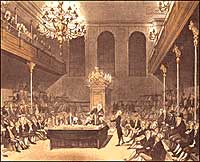
Rudolph Ackermann 1808
The House of Commons and the House of Lords combine to form United kingdom of great britain and northern ireland's Parliament. Charles Townshend was a member of the House of Commons when he convinced Parliament to impose a new tax on the American colonies in 1767.
After the Postage stamp Act was repealed, the human relationship betwixt England and the American colonies was still shaky. "Nervous tension" is the term that best describes it. Many issues remained unresolved. It was hard for England to enforce regulations from across the sea. Still, the British Parliament did non desire the colonists to think that they were giving upwardly potency over the colonies. So, immediately after repealing the Stamp Human activity, Parliament issued the Declaratory Act.
The Declaratory Act stated that Parliament had complete control over the governing of the colonies in "all cases whatsoever." The British were not willing to give up any control to the colonies. In the colonies, leaders had been glad when the Postage Act was repealed, merely the Declaratory Deed was a new threat to their independence. It was 1766, and to well-nigh colonists, the ability of England to tax the colonies without giving them representation in Parliament was seen as disgraceful. The rebellion confronting the Postage stamp Human action was proof of this view. Merely the right for Parliament to make laws in other areas was adequate. The intent of the Declaratory Human activity was not clear, though. "All cases whatsoever" could surely mean the power to revenue enhancement. Colonial leaders waited anxiously for the outcome to resurface.
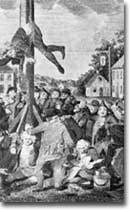
Every bit Britain connected to impose taxes on the colonists, reactions turned tearing toward tories (colonists loyal to Britain) and British officials.
Sure plenty, the "truce" did not final long. Dorsum in London, Charles Townshend persuaded the Business firm of Commons to tax the Americans one time again. This time, though, at that place would be an import tax on such items equally glass, paper, lead, and tea.
The Ties that Demark
Charles Townshend had two reasons for introducing new taxes into Parliament. He wanted to collect money from the colonies, but he also wanted more power for United kingdom. His thought was to use the taxes to pay the colonial governors. This was a large modify. Earlier, the colonies paid their ain governors. That manner, if people were non satisfied with the governor'due south leadership, they could cutting his bacon. The legislature could basically bribery the governor into doing what they wanted. In one case the salary procedure changed, the governors could be complimentary to oppose the colonial assemblies. Instead, they would be more tied to Parliament.
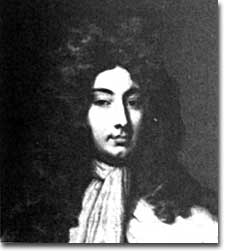
Charles Townshend, Chancellor of the Exchequer, sponsored the Townshend Acts. He believed that the Townshend Acts would assert British authority over the colonies besides as increase revenue.
Townshend also created an American Board of Customs Commissioners. Officials from this group would be stationed in the colonies to enforce tax policy on imports and other goods. Customs officials received bonuses for every smuggler that got bedevilled, and then they had reasons to desire to take hold of and capture colonists.
Finally, Townshend began putting pressure on the colonies to obey and back up Britain. He even suspended the New York legislature because they did non have enough supplies for the British troops stationed at that place. Every bit the pressure increased, it seemed like a conflict was bound to happen.
You are Charles Townshend. Write a brusque letter to the New York legislature telling them why you lot have decided to shut them down.
SKILLS: Analyze, Create
Just as they did during the Postage stamp Act, colonists reacted to the utilize of force from Britain. Not beingness allowed to import goods meant that smuggling increased. Tax collectors and merchants who violated the boycotts were ofttimes harassed. The colonial assemblies sprang into action to try to improve conditions for their people.
You lot are a smuggler talking to your 12-yr-erstwhile son about your business concern. Practice you encourage him to follow in your footsteps? Why?
SKILLS: Analyze, Create
Accept It Back
In a letter to the other colonies, the Massachusetts legislature recommended that the 13 colonies take activeness against Parliament. As a response, Parliament voted to dissolve the Massachusetts legislature. But colonial assemblies reacted strongly and voiced support of Massachusetts past supporting the letter of the alphabet. Feelings of disgust for Britain were growing.
More Information on the Massachusetts Circular Letter
Samuel Adams wrote the Massachusetts Round Letter of the alphabet in 1768. The letter was a petition inviting all of the colonies to unite confronting Britain. In it, Massachusetts said that it was wrong for England to tax the colonies without giving them representatives in Parliament — "revenue enhancement without representation." When news of the letter of the alphabet came to England, Lord Hillsborough warned colonial legislatures confronting promoting whatever such ideas. He threatened to remove powers from whatsoever colony that joined Massachusetts' campaign. Even and so, many legislative assemblies throughout the colonies, including New York, Rhode Island, and New Jersey, spoke out against "taxation without representation" and accustomed the petition written past Samuel Adams.
The more rules the British tried to enforce, the more the colonists rebelled and resisted. By 1769, British merchants began to experience the sting of nonimportation. They couldn't possibly make a living. In April 1770, news of a partial repeal reached America. But at least 1 import tax was even so being collected and enforced: the revenue enhancement on tea.
- What were the central provisions of the Townshend Acts and what was the rationale of Charles Townshend and the British Parliament in passing the kind of legislation that they did?
- What was the colonists' reaction to the Act?
- Why was Parliament surprised by the colonists' reaction to the Human activity and what was the British response to the colonists?
felicianosmandertne.blogspot.com
Source: https://www.ushistory.org/declaration/lessonplan/townshend.html
0 Response to "what were the colonists reaction to the declaratory act"
Postar um comentário